Most hydraulic hose failures are not manufacturing defects. They are specification or installation errors that were built into the assembly before it ever went on the machine. The good news is that specifying a hose correctly comes down to a short, repeatable checklist. Work through it in order and you will get the right assembly nearly every time.
Start with the fluid, not the pressure
The first question is what is going through the hose. Standard hydraulic hose has an inner tube of synthetic nitrile, which is compatible with ordinary mineral hydraulic oil. Move to a phosphate ester fire-resistant fluid, a water-glycol, a biodegradable ester or a fuel, and nitrile may no longer be the right tube material. Getting this wrong produces a hose that looks fine on the outside while the tube swells, softens and eventually delaminates internally, often shedding material into the system on its way out.
So before anything else: name the fluid. If the machine has been converted to a fire-resistant fluid at some point in its life and nobody updated the hose specification, that is worth checking.
Then bore size, and be precise about it
Bore size determines fluid velocity, and velocity determines pressure drop and heat generation. Undersize a hose and you get a system that runs hot, loses efficiency and wastes energy heating oil rather than doing work. Oversize it and you have paid for hose and fittings you did not need, and made the routing harder than it needed to be.
The correct approach is to match the bore to the port size and flow rate the circuit was designed around. If you are replacing an existing assembly, the simplest and most reliable method is to measure the old one rather than guess: bore size is normally marked on the hose layline, along with the grade and the manufacturing date.
Pressure: working, not burst
Hose is selected on its maximum working pressure, which must be at or above the system's maximum operating pressure — including pressure spikes, not just the relief valve setting. Burst pressure is a test figure with a safety factor built in, and it is not the number you design to. A circuit that regularly sees spikes when a valve closes sharply is working the hose harder than the gauge suggests.
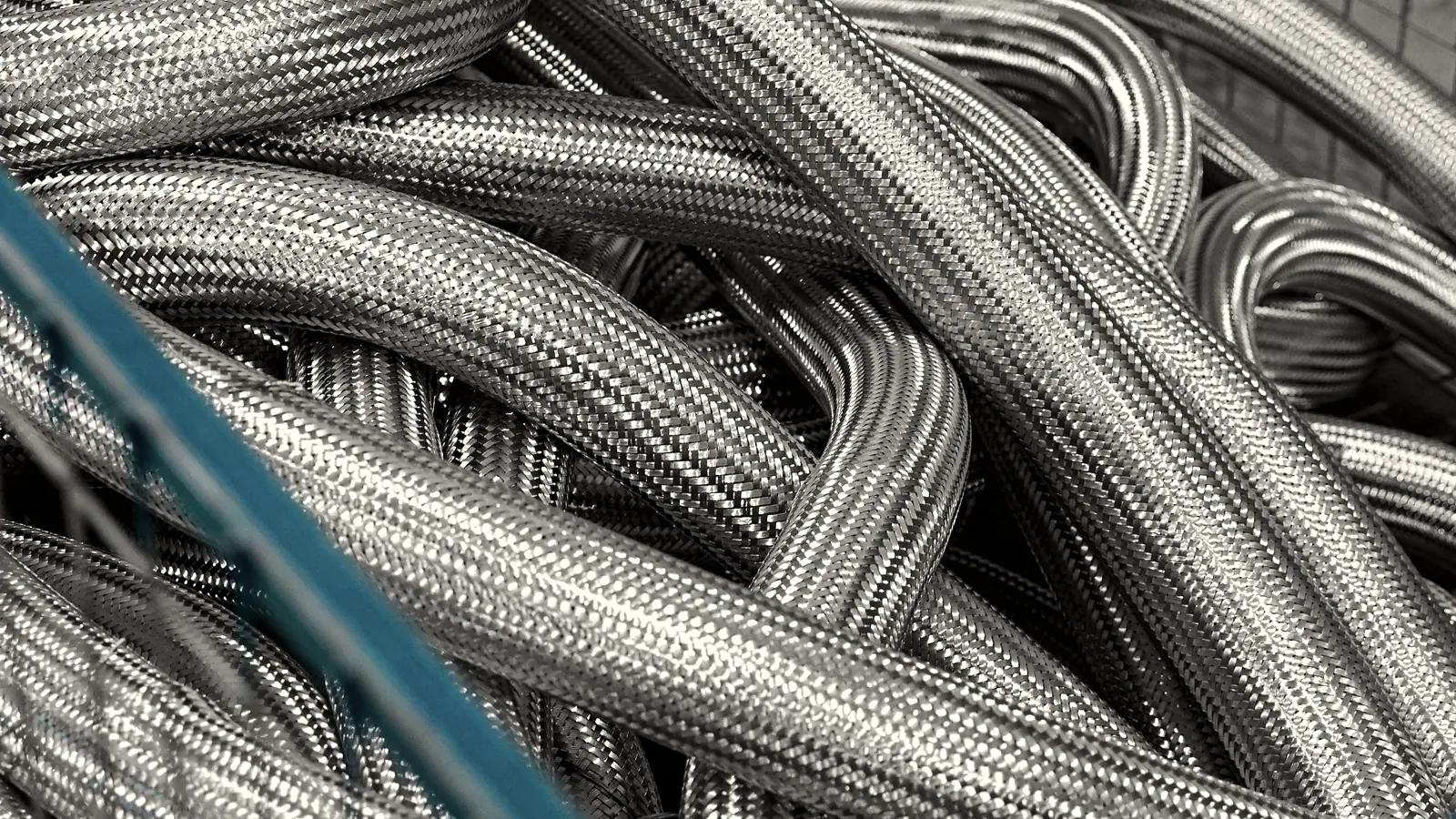
Grades are the shorthand here. One-wire braid hose to SAE 100R1AT or EN 853 1SN suits lower-pressure return and suction-side work. Two-wire braid to SAE 100R2AT or EN 853 2SN is the general-purpose choice for most mobile and industrial circuits. Where working pressures and impulse cycling are higher — the boom circuits on larger excavators, for example — four- and six-spiral hose to EN 856 4SP and 4SH is the appropriate step up. Our hydraulic hose and fittings range covers all of these grades.
Temperature, at both ends of the range
Two temperatures matter: the fluid temperature inside the hose and the ambient temperature outside it. In the Eastern Province the ambient side deserves real attention. A hose routed near an exhaust manifold or against a hot casting is being cooked from outside while it carries hot oil inside, and elevated temperature is the single fastest way to shorten hose life. Where you cannot re-route, heat sleeving is a cheap and effective answer.
Ends: the part that gets ordered wrong most often
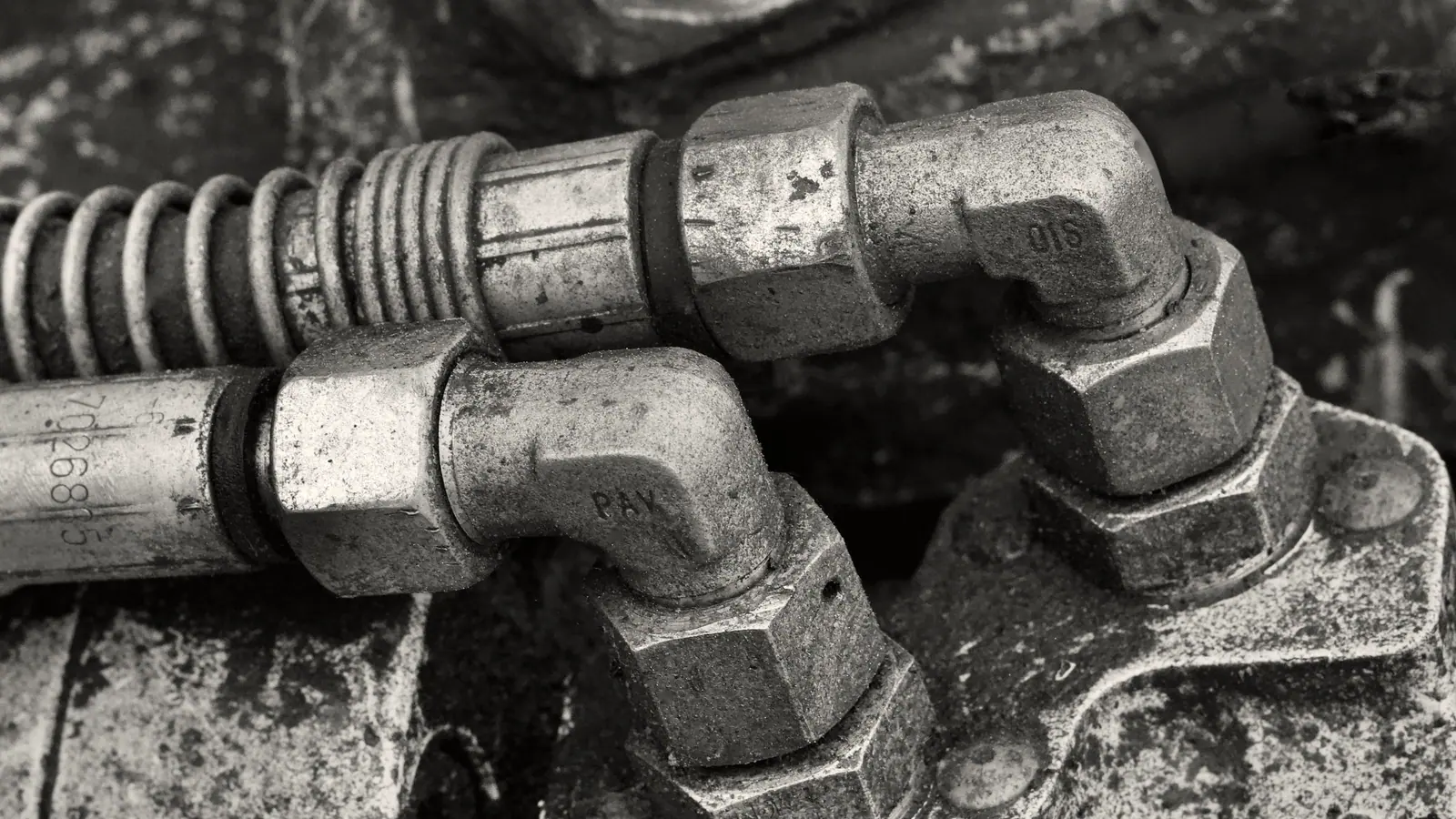
Thread type is where replacement assemblies most commonly fail on arrival. JIC 37° flare, BSPP with a 60° cone seat, BSPT, NPT, ORFS and DIN 2353 metric are not interchangeable, and several of them will start to thread together far enough to look like a match before leaking under pressure.
If you have the old assembly, keep it and send it, or photograph the ends clearly. If you do not, you need thread diameter, pitch, and the seat type — cone, flat face, or taper. Also record the orientation between the two ends, because on a hose with two 90° elbows the angle between them is what makes the assembly fit the machine.
Routing and length
Length should be measured on the machine, following the actual route, with the hose neither taut nor slack. Hose changes length slightly under pressure, so an assembly cut exactly to a straight-line dimension will be under tension in service. Allow a gentle curve rather than a straight run.
Two routing rules prevent a large share of premature failures. First, never twist a hose during installation. A hose twisted along its axis loses a significant portion of its life, and it is easy to do accidentally when tightening the second fitting — hold the hex, do not let the hose rotate. Second, respect the minimum bend radius. Tight bends near a fitting concentrate stress exactly where the hose is least able to flex, and that is where the failure appears.
Abrasion, which is what actually kills most hoses
On working machinery, more hoses fail from rubbing than from pressure. A hose resting against a chassis rail or crossing another hose will wear through the cover, expose the wire reinforcement, allow it to corrode, and fail. Clamping hoses properly, and fitting spiral wrap or sleeving where contact cannot be designed out, is inexpensive insurance. In sandy environments the abrasion rate is higher than the same installation would see elsewhere.
Assembly and testing
Hose assemblies should be crimped with the correct die for the ferrule and hose combination, to the manufacturer's crimp diameter, and then pressure tested. A crimp that is too loose will blow the fitting off under pressure; too tight and the wire reinforcement is damaged at exactly the point of highest stress. This is not a job to be done by eye. Assemblies should also be cleaned after cutting — cutting swarf left in a new hose goes straight into a pump.
A practical checklist
When you send an enquiry for a hose assembly, the following makes it answerable first time: fluid type, bore size, hose grade or maximum working pressure, overall length, both end types and sizes, the orientation between the ends, and the operating temperature. If that sounds like a lot to gather, the shortcut is to send the failed assembly or a clear photograph of it, along with the machine make and model.
If you are setting up to make your own assemblies, our hydraulic tools and workshop equipment range covers crimping machines, cutting equipment and die sets. And because hose is only one part of a circuit, it is usually worth checking filtration and sealing at the same time — a hose that failed because the fluid was contaminated will be followed by another one. Our hydraulic oils, filters and seals page covers that side.
If you would like an assembly quoted, send the details or the sample through our contact page and we will price it against your specification.
Updated 6 September 2026