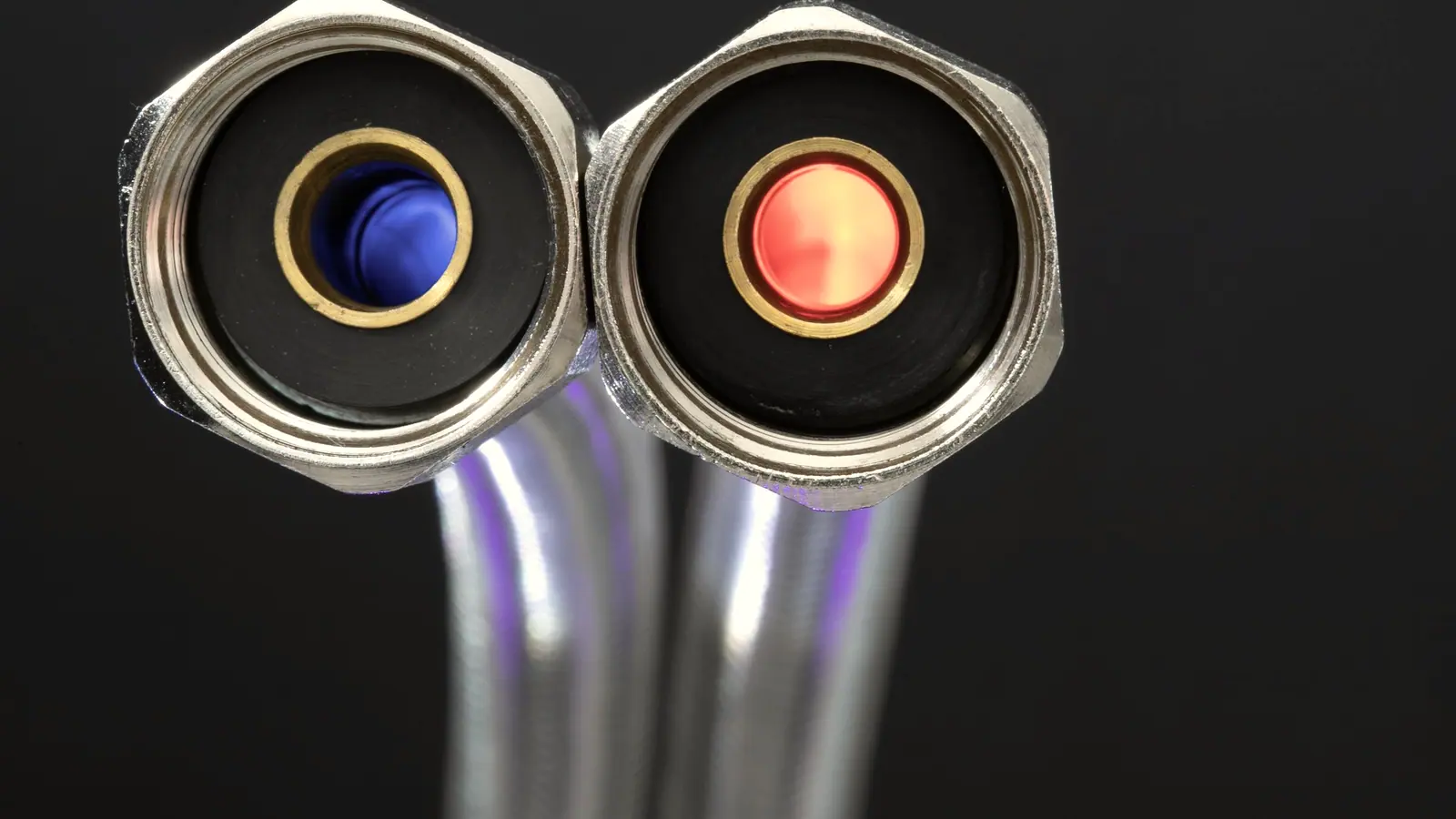
When a hose assembly is replaced and does not fit, the hose itself is almost never the problem. The bore and the pressure rating are easy to get right. The ends are where it goes wrong, because several fitting families look nearly identical, some will thread together happily and then leak, and a few will start to thread and then damage the port.
This is how to work out what you are holding, using tools you can get hold of, and what to photograph if you would rather someone else identified it.
First: parallel or tapered
This is the single most useful distinction, and you can often see it. Lay a straight edge along the thread. If the crests run parallel to the axis, the thread is parallel. If they close in towards the end, it is tapered.
Tapered threads seal on the thread itself, deforming as they tighten. Parallel threads do not — they seal somewhere else, on a cone, a flat face with an O-ring, or a bonded washer. Fitting a parallel male into a tapered female will start, feel like it is working, and then either weep permanently or split the port when someone tries to cure the weep with more torque.
The 37° cone: JIC
JIC (SAE J514, 37°) is the most common hydraulic end in general machinery. The male has a parallel thread and a 37° cone seat; the female has a matching 37° flare. The seal is metal to metal on the cone, not on the thread.
Its dangerous neighbour is the SAE 45° flare, used in refrigeration and some automotive work. The threads on certain sizes are close enough to assemble. The seats are not, and an eight-degree mismatch on a cone seat leaks under pressure. If a joint that "went together fine" weeps and never stops, this is a prime suspect.
Check the angle with a seat angle gauge rather than judging it by eye. Nobody can see eight degrees reliably.
ORFS, and why it is not a JIC
ORFS (SAE J1453, O-ring face seal) has a parallel thread and a flat face with an O-ring set into a groove. It seals when the flat faces meet and compress the O-ring. It is common on newer equipment because it tolerates vibration well.
It is easy to tell from JIC once you look at the end: a JIC male comes to a cone, an ORFS male is flat with a visible O-ring groove. If the O-ring is missing — and on a failed assembly it often is — the groove is still there.
Do not confuse ORFS with SAE O-ring boss (ORB). ORB is a straight thread with an O-ring that seals against a machined face at the base of the port, so the O-ring sits at the bottom of the thread rather than on the end face. ORB is a port connection; ORFS is a tube or hose connection.
BSPP, BSPT and NPT: the three that get confused
This is where most misidentification happens, particularly on equipment assembled from mixed sources.
- BSPP (British Standard Pipe Parallel, designated G) — parallel thread, 55° thread form. Seals on a bonded washer, an O-ring, or a 60° cone seat inside the female. Very common on European and Asian-built equipment.
- BSPT (tapered, designated R) — 55° thread form, tapered. Seals on the thread.
- NPT (American, National Pipe Taper) — 60° thread form, tapered. Seals on the thread.
BSPT and NPT are the classic trap. They are both tapered pipe threads of similar diameter, and in some sizes they will thread together for a couple of turns before binding or leaking. The thread form differs (55° against 60°) and the pitch differs in most sizes — but not all. At 1/2 inch, both BSP and NPT are 14 threads per inch, and the male diameters are close enough that a tape measure will not separate them. That size is the one to be most careful with: identify it by thread form and by what the female seals against, not by counting threads alone.
DIN 2353: light and heavy
DIN 2353 (also called compression or bite-type) uses a 24° cone inside the female and a metric parallel thread. It comes in a light series (L) and a heavy series (S) for higher pressures, and the two are not interchangeable — for a given tube size the heavy series has a larger thread and a thicker wall.
Metric threads are specified as diameter and pitch in millimetres — M18 × 1.5, for example — not in threads per inch. If someone tells you a fitting is "18 millimetre", that is the thread diameter, and the pitch still has to be established.
How to measure it properly
- Measure the male thread across the crests with vernier calipers. For a female, measure across the roots. Do not measure the hose bore and assume the thread follows — they are unrelated.
- Use a thread pitch gauge. For imperial threads it gives threads per inch; for metric it gives pitch in millimetres. Guessing pitch from appearance is unreliable.
- Use a seat angle gauge on the cone. 37°, 45°, 24° and 60° all exist in this world and they are not interchangeable.
- Note what the female seals against — a cone, a flat face with an O-ring, a washer seat, or the thread itself. This often identifies the family on its own.
One further check worth doing: a fitting that has been over-torqued, cross-threaded or previously mismatched may measure oddly because it is damaged. If two ends of the same assembly disagree with each other, suspect the joint that was leaking.
If you would rather not measure it
Photograph three things and send them:
- The seat face, square on. Straight down the bore, so the cone angle or the flat face and O-ring groove is visible.
- The thread from the side, against a ruler or caliper. Close enough to see whether the crests run parallel or taper.
- The ferrule or fitting stamp. Most crimped fittings carry a part number, a size code and sometimes the hose specification. That stamp alone often identifies the whole assembly.
Add the overall length between sealing faces and the orientation of any elbow, and the assembly can usually be made up without the old one being sent in at all. Getting this right first time is the difference between a machine running this afternoon and a second trip tomorrow.
We make up hose assemblies to sample, drawing or part number, and identify fittings from photographs where the old assembly is destroyed. See Hydraulic Hoses & Fittings and Hose Assembly & On-Site Service, or send the three photographs above through our contact form.
Updated 7 September 2026