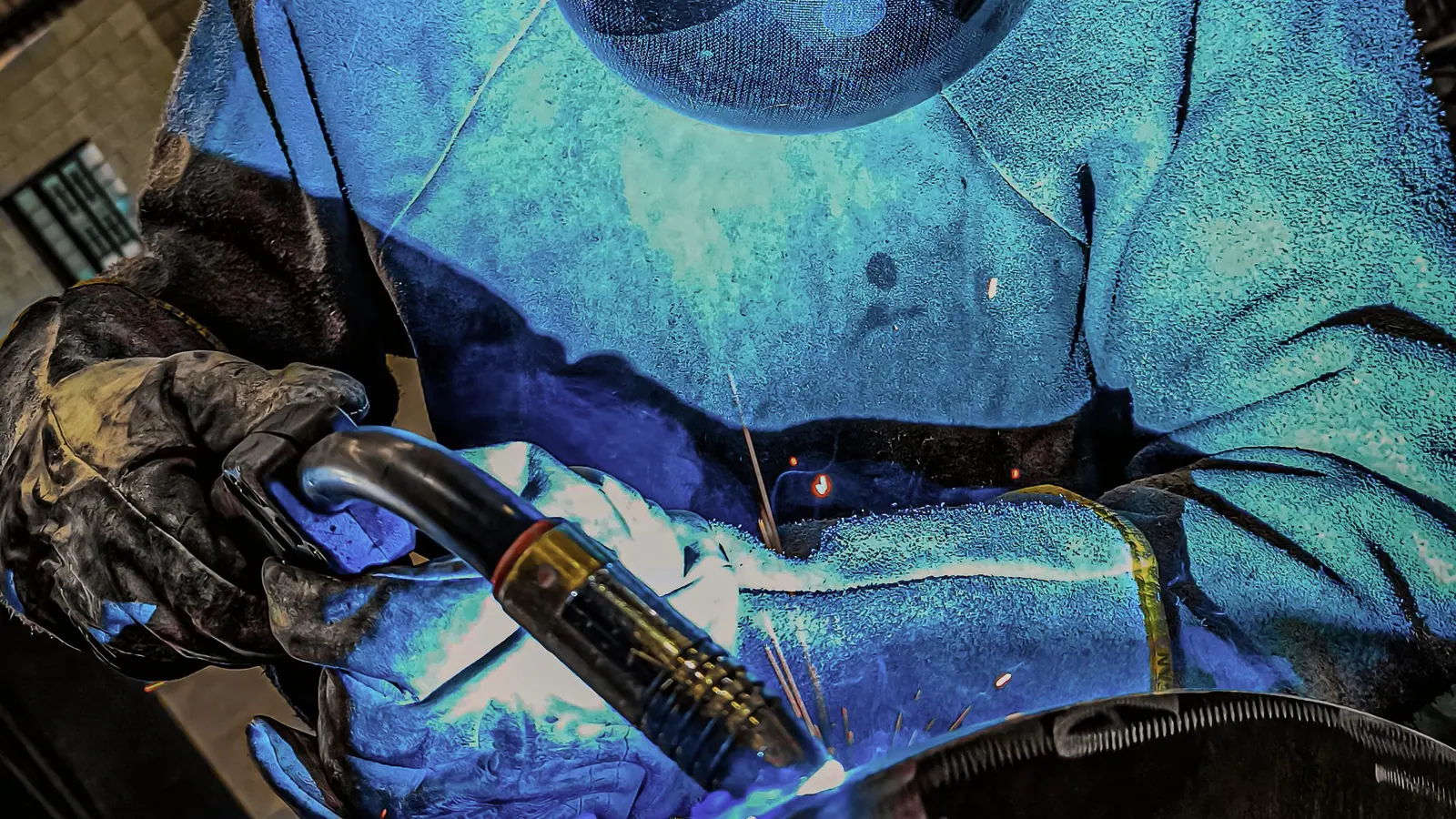
Hot work means anything capable of providing a source of ignition: welding, cutting, grinding, gouging, and often anything using a naked flame or generating sparks. On a live industrial site, none of it starts without a permit.
Most explanations of hot work permits are written for the person issuing one. This is written from the other side of the barrier — the crew standing next to a welding set, waiting. If you are buying fabrication or welding on a live plant, the delay this describes is a real cost, and much of it is inside your control rather than the contractor's.
Who raises the permit, and who accepts it
The permit is raised and authorised by the party responsible for the area — plant, facility or vessel — not by the contractor doing the work. The contractor's supervisor accepts it, which means accepting the conditions written on it, and those conditions bind the crew until the permit is closed.
This is worth understanding when programme is discussed, because it means the contractor cannot simply start earlier. A crew can be on site, competent, equipped and idle, because the document that lets them work has not been signed.
Gas testing: one reading, or continuous
Before the permit is issued, the atmosphere is tested by a competent gas tester. The test establishes that flammable vapour is below the threshold the site sets, and depending on the location it will also cover oxygen content and toxic gases.
The distinction that matters for scheduling is between a single reading before work starts and continuous monitoring throughout. Where flammable vapour could plausibly accumulate or drift into the work area — near drains, sumps, tank farms, process lines that have carried hydrocarbon, or confined spaces — a single reading at 07:00 says nothing about conditions at 11:00. Continuous monitoring means a detector stays in the work area and someone is watching it, and work stops if it alarms.
A permit that requires continuous monitoring needs the monitoring in place before work starts. If that resource is shared across the plant, the crew waits.
The clearance radius, and why it is measured downwards too
The permit specifies an area around the work that must be clear of combustibles, and the distance is set by the site's own procedure. What people forget is that sparks and hot slag fall, roll and travel: the clearance is not just a circle on the deck around the welder. It includes what is below the work through grating and floor openings, and what is behind partitions and inside adjacent equipment.
Where combustibles cannot be removed, they are covered with fire blankets or screens, and drains and openings within the radius are sealed. Preparing this is often the single biggest block of time before an arc is struck, and it is work a client's own team can do in advance.
Fire watch, and the part that runs after the work finishes
A fire watch is a named person whose only job is watching for ignition — not helping, not fetching, not fitting up. They need the means to raise an alarm and to tackle an incipient fire, and they need to be able to see the areas where slag could have landed, including the level below.
Critically, the fire watch continues for a defined period after the last arc, because smouldering material can take time to develop. The duration is set by the site's procedure. This is the requirement most often underestimated in programme: the crew cannot pack up and leave when the welding stops.
Permit closure and handback
The permit is closed by the crew and accepted back by the area authority. Closure normally requires the work area left clear, equipment removed, the fire watch period completed, and any isolation reinstated or handed on. A permit left open at the end of shift is a finding, and on many sites it delays the next day's issue.
Why a crew arrives at 06:00 and welds at 11:00
Assemble the pieces above and the sequence is unremarkable: gate access and induction; toolbox talk; the permit request queued behind other permits at the same authority; the equipment not yet isolated; gas testing; clearance of combustibles that nobody had moved; sourcing a monitor because continuous monitoring was specified; and finally, arc. Not one of those steps is negligence, and none of them is the welder's decision.
What a client can prepare to collapse that delay
- Pre-register the contractor. Gate passes and inductions handled before the mobilisation date rather than on it.
- Have the isolation done. Equipment isolated, drained and made safe by the people who own it.
- Clear the radius in advance. Combustibles removed, drains covered, adjacent areas checked below the work.
- Confirm the monitoring requirement early. If continuous monitoring is needed, whose detector and whose person.
- Name the fire watch. Whether the contractor supplies it or the site does — this is a scope question that is often left ambiguous and discovered on the morning.
- Book the permit slot. Where the authority issues at set times, the difference between the first slot and the third is hours.
How permit delay is treated commercially
This is worth settling before the job rather than after, because the two common pricing models treat it very differently.
On a day rate, the client is paying for the crew's time on site, and permit delay is chargeable time — the crew was available and the work was not released. On a lump sum, the contractor has priced an assumed number of productive hours; if permit conditions consume them, the difference becomes a variation, and variations are argued about after the fact.
The practical answer is to say in the enquiry what the permit regime is, whether continuous monitoring applies, who provides the fire watch, and what hours the permit office issues. A contractor who knows that prices it. A contractor who does not, prices optimistically and claims later.
We carry out welding, fabrication and maintenance on live sites under the client's permit regime, and price mobilisation and permit conditions into the offer rather than discovering them on the morning. See Welding Services and Plant Maintenance & Shutdown Support, or send the scope through our contact form.
Updated 7 September 2026